
Updated 2/23/26
Paychex, Inc. (NASDAQ: PAYX) is one of the biggest names in payroll processing and human capital management, helping small and mid-sized businesses handle everything from HR to compliance. The company has built a steady, recurring revenue stream, which makes it an attractive option for investors looking for reliable dividend income.
What makes the current moment worth examining closely is that PAYX has pulled back sharply from its 52-week high, pushing the dividend yield to levels that income investors rarely see from this name. Let’s take a closer look at how it stacks up for dividend seekers in this new pricing environment.
Key Dividend Metrics
💰 Dividend Yield: 4.63%
📈 Recent Dividend Increase: $0.98 to $1.08 per quarter (May 2025)
🔄 Payout Ratio: 95.48%
📆 Last Dividend Payment: January 28, 2026
📉 Annual Dividend: $4.32 per share
🏦 5-Year Average Dividend Yield: ~2.70%
💪 Dividend Safety: Moderate
Dividend Overview
Paychex is currently offering a forward dividend yield of 4.63%, which sits dramatically above its five-year average yield of roughly 2.70%. That kind of spread between current and historical yield is a signal that the market has repriced the stock significantly, and income investors are now collecting a payout that would have seemed implausible just a year or two ago.
The most recent quarterly dividend came in at $1.08 per share, bringing the annualized payout to $4.32 per share. That represents a meaningful step up from the $0.98 quarterly rate that was in place through February 2025, and the raise was put into effect with the May 2025 payment. Paychex has held the $1.08 rate steady through its January 2026 payment, demonstrating consistency even as the broader market has grown more volatile.
The payout ratio has climbed to 95.48% based on trailing EPS of $4.42, which is the most significant caution flag in the current dividend picture. While Paychex’s free cash flow provides more meaningful coverage than earnings alone suggest, the headline ratio is elevated and demands attention from income-focused investors.
Dividend Growth and Safety
The dividend growth trajectory for Paychex tells a reassuring story when examined across recent history. The company paid $0.89 per quarter through early 2024, raised the rate to $0.98 beginning with the May 2024 payment, and then pushed it further to $1.08 starting in May 2025. That progression represents cumulative growth of roughly 21% in just two years, which is a pace most income investors would happily accept from a business of this quality.
Paychex has never cut its dividend, including through the 2008 financial crisis and the pandemic disruptions of 2020. That kind of consistency across economic cycles is a meaningful differentiator and speaks to the durability of the company’s recurring revenue model. Payroll and HR services are among the last things small businesses cancel, which provides a natural floor under revenue even when conditions deteriorate.
The elevated payout ratio of 95.48% based on reported EPS is worth addressing directly. Free cash flow of $2.06 billion against an annualized dividend obligation that runs well under $1.6 billion provides a more comfortable picture of coverage than the earnings-based ratio implies. Still, with earnings-based headroom this thin, a meaningful earnings miss in any given quarter would bring dividend sustainability into sharper relief. Investors should monitor earnings trends closely.
Analyst Ratings
Upgrades
With PAYX trading near the bottom of its 52-week range at $87.39, some analysts have begun reassessing the risk-reward profile. The sharp pullback from the 52-week high of $161.24 represents a decline of nearly 46%, which has attracted attention from value-oriented analysts who view the current price as disconnected from the underlying business fundamentals. The company’s operating cash flow of $2.22 billion and its historically stable revenue base provide a foundation for a more constructive view at these levels.
Downgrades
The magnitude of the stock’s decline from its highs reflects broader analyst concern about valuation compression in the software and HR technology sector, as well as questions about near-term earnings growth. With a payout ratio approaching 100% on a reported earnings basis, some analysts have flagged limited flexibility for dividend acceleration. The competitive landscape in payroll and HR software remains intense, with ADP and a range of cloud-native competitors continuing to invest aggressively in product development and customer acquisition.
Consensus Price Target
Given that PAYX is trading at $87.39 against a 52-week high of $161.24, the stock appears to be pricing in a materially more pessimistic scenario than its operating results currently support. Revenue of $6.03 billion, net income of nearly $1.60 billion, and free cash flow of $2.06 billion describe a business that remains highly profitable and cash generative. Investors evaluating the stock at current levels should weigh whether the sell-off reflects a genuine deterioration in business quality or a broader de-rating of high-multiple software names, because the distinction has significant implications for forward returns.
Earnings Report Summary
Paychex’s most recent full-year financials reflect a business that continues to generate substantial profits and cash flow, even as the stock has repriced sharply lower. Total revenue reached $6.03 billion, and the company converted that top-line result into net income of $1.60 billion, producing a profit margin of 26.45%. That margin profile is the hallmark of a business with genuine pricing power and an efficient operating model.
EPS came in at $4.42 for the trailing period, which is the figure against which the current $4.32 annual dividend is measured. Operating cash flow of $2.22 billion and free cash flow of $2.06 billion both comfortably exceed the total dividend obligation, reinforcing that the payout is better supported on a cash basis than the headline payout ratio suggests.
Return on equity of 40.88% is exceptional by any standard and reflects the capital-light nature of Paychex’s software and services model. Return on assets of 11.64% is similarly strong. These figures indicate that the company is deploying its asset base very efficiently, which is a quality characteristic that tends to support durable dividend-paying capacity over time.
Management Solutions and Professional Employer Organization services continue to be the core revenue drivers, and both segments benefit from the sticky, recurring nature of payroll and HR contracts. Small and mid-sized business clients tend to renew their Paychex relationships at high rates once the administrative infrastructure is embedded, which creates a reliable revenue floor that most cyclical businesses cannot match.
Paychex continues to return substantial capital to shareholders through dividends, and the balance between growth investment and shareholder returns has historically been a point of management discipline. The company’s strong free cash flow generation gives it flexibility to sustain the current dividend without straining the balance sheet, even at a payout ratio that looks stretched on an earnings basis.
Financial Health and Stability
Paychex maintains a conservative financial structure that has historically supported its dividend through various economic environments. The company’s return on equity of 40.88% and return on assets of 11.64% reflect the capital efficiency of a business built on subscription-like payroll and HR service contracts rather than capital-intensive assets.
Operating cash flow of $2.22 billion and free cash flow of $2.06 billion are the most important numbers for dividend investors to track, as they represent the actual cash the business generates to fund shareholder distributions, technology investment, and any opportunistic capital allocation. With a book value per share of $10.81 and a price-to-book ratio of 8.08, the stock trades at a significant premium to tangible book value, which is typical for a high-return software and services business but does indicate that the premium is assigned entirely to earnings power and brand rather than hard assets. The company’s low beta of 0.89 suggests its stock tends to be somewhat less volatile than the broader market over time, though the current 52-week drawdown demonstrates that elevated-multiple software names can experience sharp corrections when sentiment shifts.
Valuation and Stock Performance
Paychex is currently trading at $87.39 per share, against a 52-week range of $87.04 to $161.24. The stock is essentially at the bottom of its annual range, a positioning that stands in stark contrast to where it traded just several months ago. The trailing P/E ratio of 19.77 represents a significant de-rating from the premium multiples the stock carried through much of the past several years, and for long-term income investors, the current price introduces a dividend yield of 4.63% that is nearly double the stock’s five-year average.
Valuation Metrics
- Trailing P/E Ratio: 19.77
- Price-to-Book Ratio: 8.08
- Book Value Per Share: $10.81
- Market Cap: approximately $31.4 billion
A P/E of 19.77 for a business generating 26.45% profit margins and 40.88% return on equity is a notably different proposition than paying 30 times earnings for the same company, as investors were doing less than a year ago. Whether this repricing represents a durable reset or an overcorrection will depend heavily on near-term earnings trajectory and the broader market’s appetite for software and HR technology names.
Stock Performance
- 52-Week Range: $87.04 to $161.24
- Beta: 0.89
- Current Price: $87.39
The stock’s decline from $161.24 to $87.39 over the past year is a reminder that even high-quality, dividend-growing businesses are not immune to valuation compression. For income investors with a multi-year horizon, the question is whether the business fundamentals support the dividend at this price, and the free cash flow data suggests they do. For total return investors, the current price may represent a more attractive entry point than anything available over the prior two to three years.
Risks and Considerations
No stock is without risk, and Paychex carries several that income investors should evaluate carefully at this juncture.
- Elevated Payout Ratio – At 95.48% on a reported EPS basis, the dividend leaves very little room for earnings disappointment. Free cash flow coverage is more comfortable, but any sustained earnings pressure would narrow that cushion quickly.
- Valuation Trajectory – The stock’s decline from $161 to near $87 in under a year reflects a severe multiple compression. If the market continues to de-rate software and HR technology names, further downside is possible even if operating results remain stable.
- Economic Sensitivity – Paychex serves small and mid-sized businesses, which are more vulnerable to economic downturns than large enterprises. A recession that drives elevated small business closures would reduce Paychex’s client count and pressure revenue growth.
- Competition – ADP and a growing roster of cloud-native HR and payroll platforms continue to compete aggressively for new customers. Market share dynamics bear watching, particularly among younger, faster-growing small businesses that may gravitate toward more modern software interfaces.
- Dividend Growth Pace – With the payout ratio as elevated as it currently stands, investors should not expect aggressive dividend hikes in the near term. Future increases are likely to be measured and closely tied to earnings growth.
Chart Analysis
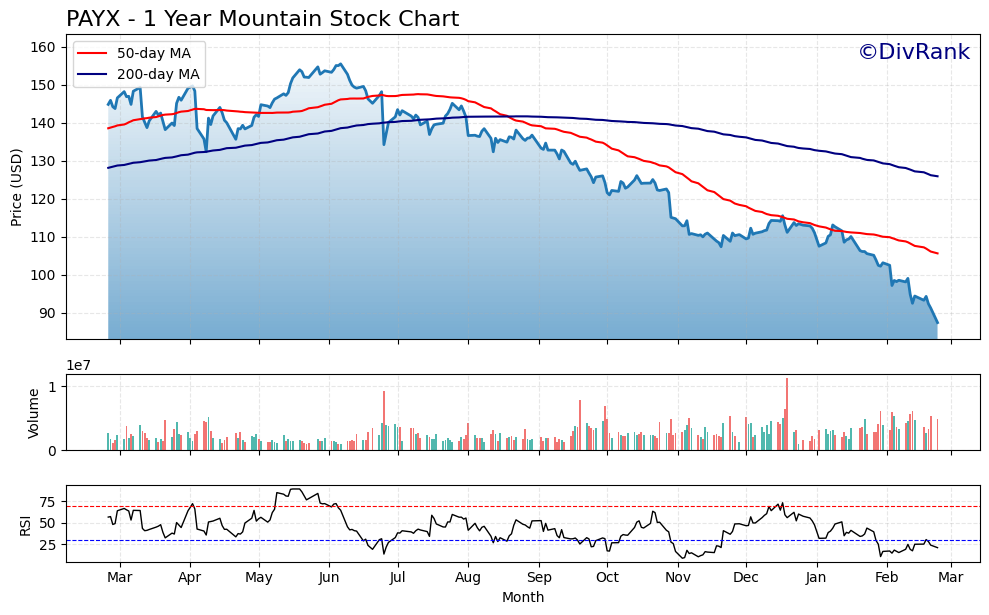
Paychex has endured a brutal twelve months of price deterioration, and the chart tells that story with unusual clarity. Shares have fallen from a 52-week high of $155.44 all the way down to the current price of $87.39, which also happens to be the 52-week low, meaning the stock is trading at its absolute worst level of the past year with no visible floor established yet. That is a drawdown of nearly 44% from peak to trough, a decline severe enough to warrant serious attention regardless of how strong the underlying business fundamentals may appear. For a stock that typically carries a reputation as a steady, low-volatility compounder in the payroll and HR services space, this kind of price action represents a meaningful departure from its historical character.
The moving average picture reinforces the bearish technical posture at every level. PAYX is trading well beneath both its 50-day moving average of $105.60 and its 200-day moving average of $125.88, and the gap between the stock price and those longer-term trend lines is substantial rather than marginal. More concerning for technically oriented investors is the confirmed death cross formation, where the 50-day moving average has crossed below the 200-day, a signal that near-term momentum has deteriorated enough to drag the shorter trend line through the longer one. This pattern historically signals that selling pressure has been both persistent and broad-based, not simply a brief corrective episode.
The RSI reading of 21.22 places Paychex in deeply oversold territory by any conventional measure, sitting well beneath the standard oversold threshold of 30. From a pure momentum standpoint, readings at this level suggest that the selling has been relentless and that the stock may be approaching a point of exhaustion among sellers. That said, oversold conditions can persist far longer than most investors expect, particularly when a stock is simultaneously sitting at a 52-week low with no technical support structure beneath it. An RSI this depressed is a data point to monitor carefully, but it is not a standalone buy signal.
For dividend investors, the chart presents a genuinely difficult backdrop to navigate. The income thesis on Paychex has not evaporated, and a stock that has declined this sharply naturally offers a more attractive starting yield for new buyers, but the technical evidence argues for patience over urgency. There is no sign yet of stabilization or base-building in the price action, and investors who prioritize capital preservation alongside income generation should treat the current level as a zone to watch rather than an obvious entry point. Waiting for either a meaningful recovery above the 50-day moving average or at minimum a multi-week consolidation at current levels would give the chart a chance to show some sign of demand returning before committing new capital.
Final Thoughts
Paychex is a well-run company with a long and unbroken dividend track record, a highly profitable recurring revenue model, and free cash flow generation that meaningfully exceeds its dividend obligation. At $87.39, the stock is offering a 4.63% yield that stands well above its historical average, and a trailing P/E of 19.77 that is far more reasonable than the valuations investors were paying just a year ago.
The elevated payout ratio is the most important caveat for dividend investors to monitor, because while free cash flow provides adequate coverage today, sustained earnings pressure could change that calculus. Income investors who have wanted exposure to Paychex’s dividend but found the yield insufficient at prior price levels now have the opportunity to collect a meaningfully higher payout while acquiring the stock near its 52-week low. The business quality is intact, the dividend history is spotless, and the current price introduces a margin of safety that has not been available from this name in quite some time.