Updated 3/11/2025
OneMain Holdings, Inc. (OMF) is a financial services company that focuses on personal loans, particularly for borrowers who might not qualify for traditional bank loans. With a strong presence across the U.S., OneMain offers both secured and unsecured loans and has built its business around consumer lending.
For income investors, the real appeal of OMF lies in its dividend. A yield of over 9% makes it a standout in the financial sector, but with a payout ratio near 100%, the big question is whether this dividend is sustainable in the long run. Let’s dive into the details to see what’s under the hood.
Key Dividend Metrics
📌 Dividend Yield: 9.05% (forward)
📌 Annual Dividend: $4.16 per share
📌 Payout Ratio: 97.17%
📌 5-Year Average Dividend Yield: 9.10%
📌 Ex-Dividend Date: February 12, 2025
📌 Dividend Payment Date: February 20, 2025
A yield this high is always a double-edged sword. While it offers a strong income stream, it also signals that the market sees risk in the business. And with a payout ratio this high, it’s fair to ask how much longer the company can keep paying out at this level.
Dividend Overview
OneMain has built a reputation as a high-yield dividend stock, consistently offering investors a return well above the average in the financial sector. For those looking for an immediate income stream, this can be an attractive option.
However, a dividend yield above 9% doesn’t come without its challenges. The company’s payout ratio is concerning, as it leaves little room for reinvestment. In simpler terms, OneMain is paying out nearly all of its earnings to shareholders, which means if earnings take a hit, the dividend could be at risk.
For now, the company has continued to make payments, which is a positive sign. But investors should keep an eye on earnings trends to see if this remains sustainable.
Dividend Growth and Safety
🟢 Stable Payments – OneMain has maintained its dividend without cuts in recent years.
🟡 Slow Growth – The company prioritizes a high yield over increasing payouts.
🔴 High Payout Ratio – A near-100% payout ratio suggests risk if earnings decline.
OneMain isn’t what you’d call a dividend growth stock. Unlike companies that steadily raise their payouts, OneMain has focused more on maintaining a high yield. While that works for some investors, it does mean there’s little room for dividend increases.
The biggest risk here is a potential cut. If the company’s earnings shrink, management may have no choice but to trim the dividend to keep the business financially sound. For those relying on steady income, that’s something to consider.
Chart Analysis
Price Action and Trend
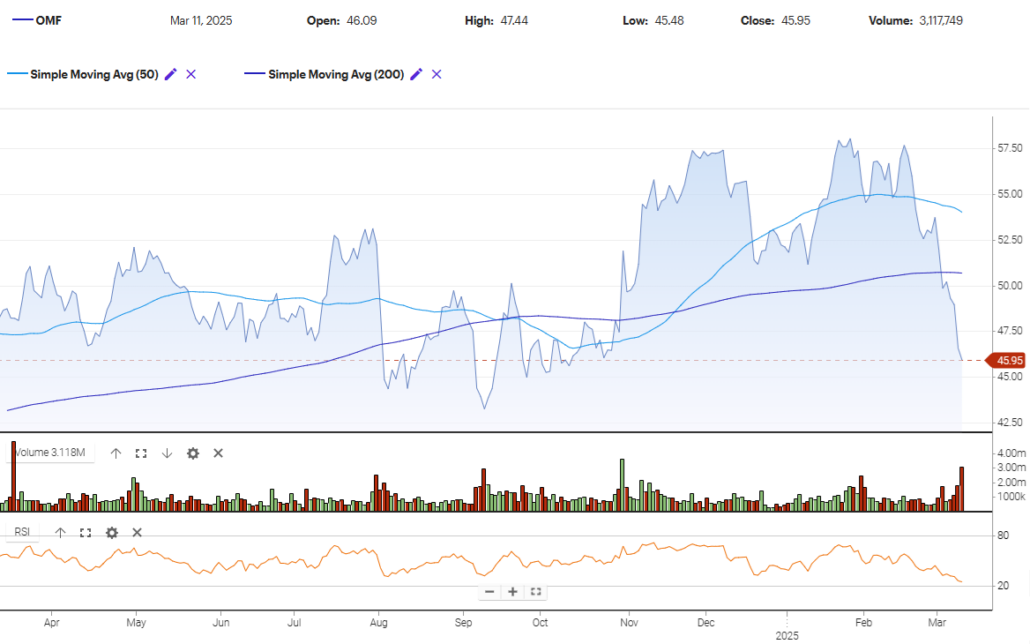
The stock has been in a steady uptrend for much of the past year, reaching highs above 57.50 before pulling back sharply in recent weeks. The price is now trading near 45.95, which is a significant decline from recent highs.
One key technical development is that the stock has fallen below both the 50-day and 200-day moving averages. This suggests a shift in sentiment, as the shorter-term momentum has weakened and long-term investors may be taking profits or adjusting their positions. The breakdown below these moving averages can sometimes lead to further selling pressure if buyers don’t step in.
Moving Averages
The 50-day moving average had been trending higher for several months but recently turned downward, signaling a possible loss of bullish momentum. Meanwhile, the 200-day moving average is still rising but is beginning to flatten out. When the 50-day moving average crosses below the 200-day moving average, it creates what’s known as a death cross, which can be a bearish signal if downward momentum continues.
Volume and Market Participation
The recent decline in price has been accompanied by a noticeable increase in trading volume. This suggests that sellers are in control, with a higher level of activity during the selloff. Heavy volume on a downward move can indicate that institutional investors are reducing positions, adding to downward pressure.
At the same time, volume spikes near support levels can sometimes signal potential accumulation by long-term buyers, so watching how volume behaves in the coming sessions will be important.
Relative Strength Index (RSI)
The RSI indicator has been moving lower and is now approaching oversold territory. Generally, an RSI reading below 30 suggests that a stock may be oversold, which sometimes leads to a short-term bounce or consolidation. However, if the stock continues to decline despite an oversold RSI, it can indicate that selling pressure is still strong and buyers are hesitant to step in.
Support and Resistance Levels
Looking at recent price action, 45 appears to be a key support level. If the stock holds around this level, there could be a potential bounce, but if it breaks lower, the next level of support may be near 42.50.
On the upside, the 50 area now acts as resistance, as it aligns with both moving averages and a key psychological level. For any recovery to gain traction, the stock would need to move back above the 50-day moving average and stabilize.
Market Sentiment and Context
The stock’s decline coincides with overall market weakness in financial stocks, as well as concerns about interest rates and consumer lending risks. Given that OneMain Holdings is in the lending business, any concerns about economic conditions and loan defaults could continue to weigh on sentiment.
Analyst Ratings
📈 Upgrades and Positive Reiterations
🔹 On February 3, 2025, RBC Capital maintained its Outperform rating on OneMain Holdings and raised its price target from $62 to $65. This adjustment reflects increased confidence in the company’s growth prospects and financial health.
🔹 Stephens & Co. also reiterated its Overweight rating with a price target of $62, pointing to strong earnings performance and an optimistic outlook for consumer lending.
🔹 Another vote of confidence came from JMP Securities, which reaffirmed its Market Outperform rating and maintained a price target of $65. Analysts at JMP believe OneMain’s management strategies and financial discipline will continue to support shareholder value.
📉 Downgrades and Cautious Outlooks
🔻 On October 8, 2024, Barclays downgraded OneMain Holdings from Overweight to Equal-Weight and reduced its price target from $52 to $46. The downgrade was based on concerns about rising credit losses and a more cautious stance on consumer lending trends.
🔻 Some analysts are also considering the broader economic landscape, where interest rate fluctuations and potential increases in delinquency rates could impact OneMain’s earnings. These factors have led to a more conservative valuation from those skeptical about near-term growth.
📊 Consensus Price Target and Market Sentiment
The average analyst price target currently sits at $58.36, suggesting a potential upside from current levels. While the overall sentiment leans positive, the presence of recent downgrades reflects a balanced view—some see strong earnings potential, while others remain cautious about external risks affecting the business. Investors should keep an eye on credit trends and economic conditions when evaluating OneMain Holdings as an investment opportunity.
Earnings Report Summary
OneMain Holdings wrapped up the fourth quarter of 2024 with a bit of a mixed bag in its earnings report. The company posted $126 million in net income, which is down from the $165 million it earned in the same period last year. That drop translated to diluted earnings per share (EPS) of $1.05, compared to $1.38 a year ago. Looking at the full-year numbers, net income came in at $509 million, down from $641 million in 2023, with EPS falling from $5.32 to $4.24.
Diving into the Consumer and Insurance (C&I) segment, the company reported $185 million in adjusted pretax income for the quarter, with $139 million in adjusted net income. Those figures were also lower than last year, when the company pulled in $223 million and $167 million, respectively. Adjusted EPS for this segment came in at $1.16, compared to $1.39 a year prior. Over the full year, adjusted net income for C&I landed at $587 million, down from $655 million, while adjusted EPS dropped from $5.43 to $4.89.
One area where OneMain saw some solid growth was in managed receivables, which climbed 11% to $24.7 billion by the end of the year. Consumer loan originations also increased 16%, hitting $3.5 billion for the quarter. Total revenue, which includes interest income and other revenues, rose 9% to $1.5 billion, largely driven by an 11% bump in interest income.
On the flip side, rising costs weighed on the company’s results. Interest expenses climbed 15% to $310 million, due to higher debt levels and increased borrowing costs. The provision for finance receivable losses also went up by $77 million, reaching $523 million for the quarter. Meanwhile, operating expenses jumped 10% to $422 million, as the company continued investing in technology and digital expansion while absorbing costs from the Foursight acquisition.
Looking at the balance sheet, OneMain ended the year with $21.7 billion in debt, about 57% of which is secured. The company held $458 million in cash and cash equivalents, including $123 million held at its insurance subsidiaries.
Despite the decline in net income and EPS, OneMain remains committed to rewarding shareholders. The company declared a $1.04 per share dividend, payable on February 20, 2025, and repurchased 75,000 shares for $3 million during the quarter.
Overall, the company saw some solid growth in lending activity, but higher costs and loan loss provisions put some pressure on earnings. With continued investment in digital capabilities and a focus on maintaining strong liquidity, OneMain is positioning itself to navigate the evolving financial landscape.
Financial Health and Stability
When evaluating dividend stocks, financial health is just as important as yield. Here’s how OneMain stacks up:
✔️ Profit Margin: 20.38% – Solid profitability for a lending company.
✔️ Return on Equity (ROE): 15.96% – A strong return for shareholders.
⚠️ Debt-to-Equity: 676.90% – Very high, which could be a concern.
OneMain is profitable and brings in solid margins, which is a good sign. But the elephant in the room is the company’s debt. With a debt-to-equity ratio approaching 700%, OneMain is heavily leveraged.
This is common in the lending business, but it does mean that the company is exposed to interest rate changes and potential downturns in consumer lending. If borrowing costs rise or the economy slows, OneMain could feel the squeeze.
There’s also the issue of declining earnings. The company’s most recent quarter showed a 23.6% drop in earnings year-over-year. If that trend continues, it could impact its ability to maintain the dividend.
Valuation and Stock Performance
At current prices, OneMain looks relatively cheap compared to the broader market. The stock trades at a price-to-earnings ratio of 10.84 (trailing) and 7.47 (forward), suggesting it’s not overpriced.
Recent stock performance tells a different story:
- 52-Week High: $58.90
- 52-Week Low: $41.70
- Current Price: ~$46.27
The stock has pulled back from its highs, likely due to concerns about the lending environment. With a beta of 1.57, OMF is more volatile than the broader market, meaning investors should be prepared for swings.
For those looking for value, OMF may be appealing, but it’s important to consider why the stock is trading at these levels. The market is likely pricing in the risk that earnings could decline, which could impact both stock performance and the dividend.
Risks and Considerations
1️⃣ Dividend Sustainability – A payout ratio of nearly 100% raises the risk of a future cut.
2️⃣ High Debt Load – A debt-to-equity ratio of nearly 700% means the company is highly leveraged.
3️⃣ Consumer Credit Risk – As a lender to non-prime borrowers, OneMain is exposed to potential loan defaults.
4️⃣ Stock Volatility – A beta of 1.57 means the stock can be more volatile than the market.
5️⃣ Lack of Dividend Growth – While the yield is high, there’s little room for increases.
Final Thoughts
OneMain Holdings is a high-yield dividend stock that appeals to investors looking for strong cash returns. With a yield above 9%, it’s certainly attractive for income seekers.
That being said, there are risks to consider. A payout ratio near 100% leaves little room for error, and the company’s high debt levels could make it vulnerable in tougher economic conditions. While OneMain has continued to pay dividends consistently, investors should watch earnings trends closely.
For those willing to take on more risk in exchange for a high yield, OneMain could be worth a look. But for investors focused on long-term stability and dividend growth, there may be better options. Understanding your own risk tolerance is key before committing to a stock like this.