

Updated 2/23/26
Oak Valley Bancorp (OVLY) is a regional bank rooted in California, dedicated to serving small businesses and individuals. Unlike the big national banks that focus on scale, OVLY leans into a more personal, community-driven banking model. It’s not a flashy company, but it’s a steady, reliable performer. For investors looking for a stable dividend payer in the financial sector, this bank has some attractive qualities.
Its track record of profitability and careful capital management makes it worth a closer look, especially for those who want steady income without taking on unnecessary risk. Let’s dive into the details.
Recent Events
Oak Valley Bancorp’s most notable recent development is a meaningful step up in its dividend. In February 2026, the board declared a payment of $0.375 per share, up from $0.30 per share in each of the prior two semi-annual payments. That represents a 25% increase over the previous payment and continues a pattern of accelerating distributions that has defined the bank’s capital return story in recent years. For context, the bank was paying just $0.145 per share semi-annually back in early 2021, and it has more than doubled that figure in the five years since. The latest increase signals continued confidence from management in the bank’s earnings power and balance sheet strength heading into 2026.
On the operating side, OVLY has maintained the conservative lending posture that income investors have come to expect from it. With a beta of just 0.24, the stock continues to trade with considerably lower volatility than the broader market, which suits the long-term, income-oriented shareholder well. The bank’s market capitalization now stands at approximately $277 million, keeping it firmly in small-cap territory and off the radar of most institutional mandates, but that also means patient individual investors can still find reasonable entry points without much competition.
Key Dividend Metrics
📌 Dividend Yield: 2.00%
📌 Annual Dividend: $0.75
📌 Most Recent Payment: $0.375 per share (paid February 2, 2026)
📌 Payout Ratio: 20.83%
📌 5-Year Dividend Growth: From $0.29 annualized in 2021 to $0.75 annualized in 2026
📌 Ex-Dividend Date: February 2, 2026
📌 Payment Frequency: Semi-annual
Dividend Overview
Oak Valley Bancorp currently offers a 2.00% dividend yield based on its annualized payment of $0.75 per share and a current stock price of $33.03. While that yield sits below what some higher-payout regional banks offer, the more compelling part of the OVLY dividend story is not where the yield stands today but how rapidly the payment itself has grown. The bank has moved from semi-annual payments of $0.145 in early 2021 to $0.375 in February 2026, a compounded rate of growth that few community banks can match.
The payout ratio remains extraordinarily conservative at just 20.83% of earnings. That figure reflects a bank that is keeping the vast majority of its profits on the balance sheet to fund future growth and weather any credit cycle turns, while still rewarding shareholders with a growing cash return. For dividend growth investors specifically, a low payout ratio combined with demonstrated willingness to raise the payment is a particularly attractive combination, since it means the distribution has room to expand even if earnings face near-term pressure.
Dividend Growth and Safety
Growth Potential
OVLY’s dividend history over the past five years tells a clear story of deliberate, accelerating growth. From 2020 through 2022, the bank made modest semi-annual increases of a penny or two at a time. Then in early 2024, management made a more decisive move, pushing the payment from $0.16 to $0.225 per share, a 40% jump in a single step. By early 2025, the payment rose again to $0.30, and by February 2026 it reached $0.375. That trajectory, combined with a return on equity of 12.53% and a profit margin of 29.55%, suggests a management team that is generating real earnings growth and choosing to share more of it with shareholders over time. With the payout ratio still sitting at just 20.83%, there is significant headroom to continue raising the dividend even without meaningful earnings improvement.
Stability and Safety
From a safety standpoint, OVLY’s dividend looks about as secure as they come in the regional banking space. The bank earned $2.88 per share in the most recent period, against an annual dividend obligation of just $0.75 per share, leaving an enormous cushion. The profit margin of 29.55% reflects a bank that runs a lean and disciplined operation. Net income came in at approximately $23.9 million on revenues of roughly $80.9 million, which is a solid result for a community bank of this size. Even in a scenario where earnings declined materially, the current payout would remain well-covered. That combination of a low payout ratio, consistent profitability, and a history of conservative underwriting gives income investors a high degree of confidence in the dividend’s continuity.
Chart Analysis
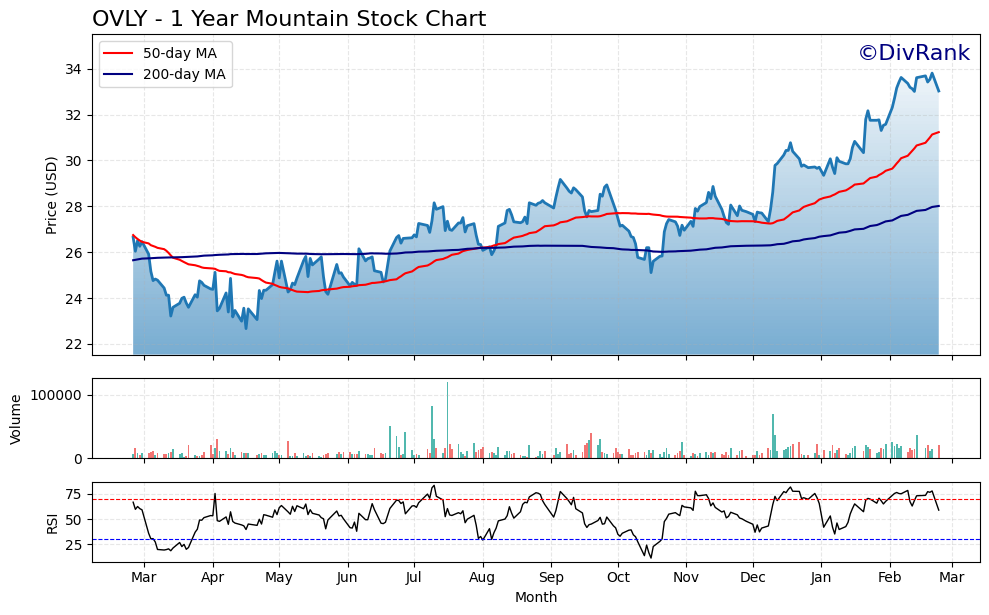
Oak Valley Bancorp has staged an impressive recovery over the past twelve months, climbing from a 52-week low of $22.67 to its current price of $33.03, a gain of roughly 45.7% from trough to present. That kind of price appreciation in a community bank is not typical, and it reflects a meaningful shift in investor sentiment toward the name. The stock is now trading within striking distance of its 52-week high of $33.81, sitting just 2.31% below that level, which tells you the momentum has been sustained rather than a brief spike followed by a pullback. For dividend investors, price stability and upward trajectory matter because they signal balance sheet confidence and reduce the risk of a distressed dividend cut.
The moving average picture is constructive. OVLY is trading above both its 50-day moving average of $31.24 and its 200-day moving average of $28.02, with the 50-day sitting comfortably above the 200-day. That configuration is known as a golden cross, and while technical signals are never guarantees, a golden cross in a small-cap bank stock tends to reflect genuine accumulation by longer-term holders rather than short-term speculation. The spread between the current price and the 200-day moving average is nearly five dollars, meaning the stock would need to retrace significantly before the longer-term trend even came into question. That kind of cushion is reassuring for income-oriented holders who are more concerned with durability than trading precision.
The Relative Strength Index currently sits at 58.91, which places OVLY in a healthy middle zone. A reading below 30 signals oversold conditions, while a reading above 70 suggests the stock may be overbought and vulnerable to a near-term pullback. At just under 59, there is still room for additional appreciation before the stock enters technically stretched territory. The momentum profile here is steady rather than frothy, which is exactly what dividend investors should want to see. A stock racing into overbought conditions often invites sharp reversals that can spook income holders, whereas a measured climb with RSI in the mid-range suggests the buying interest is deliberate and durable.
Taken together, the technical setup for OVLY is about as favorable as a dividend investor could reasonably hope to see in a community bank. The trend is up, the moving averages are aligned bullishly, momentum is positive without being excessive, and the stock is within arm’s reach of a new 52-week high. None of this replaces fundamental analysis of dividend coverage or payout sustainability, but the chart at minimum tells you that the market is not pricing in deterioration. For investors evaluating an entry point, the current setup does not flash any near-term caution signals worth acting on.
Analyst Ratings
Oak Valley Bancorp is a small-cap community bank with a market capitalization of approximately $277 million, and as is typical for institutions of this size, it does not carry a formal Wall Street consensus rating or published price target at this time. Coverage of micro and small-cap regional banks is generally sparse, and OVLY is no exception. That lack of analyst attention is, in many ways, a structural feature of the opportunity here rather than a red flag. Stocks that trade below the radar of major brokerage research departments often do so simply because they are too small to generate meaningful investment banking revenue, not because there is anything wrong with the underlying business.
Investors evaluating OVLY without sell-side guidance should lean on the fundamentals directly. A P/E ratio of 11.47 is toward the lower end of where well-run regional banks typically trade, a price-to-book ratio of 1.38 reflects modest but reasonable market confidence in the franchise’s earning power, and short interest of just 32,027 shares suggests there is virtually no bearish institutional conviction against the stock. In the absence of a formal analyst consensus, the financial data itself makes a reasonable case for fair-to-modestly-undervalued pricing.
Earnings Report Summary
Oak Valley Bancorp’s most recent full-year results show a bank that has stabilized and returned to a cleaner earnings profile after navigating the margin compression and cost pressures that weighed on 2024. The bank reported net income of approximately $23.9 million on revenues of $80.9 million, translating to earnings per share of $2.88. That compares to the $24.9 million in full-year net income reported for 2024, which itself had declined from the $30.8 million earned in 2023 as deposit funding costs surged in the higher-rate environment. The latest figures suggest the bank has absorbed much of that cost pressure and is generating a more normalized level of profitability.
The profit margin of 29.55% reflects the bank’s continued ability to price its loan book at rates that more than offset funding costs, and the return on equity of 12.53% is a respectable figure for a community bank that carries a conservative balance sheet. Book value per share currently stands at $24.01, and with the stock trading at $33.03, the market is assigning a price-to-book multiple of 1.38, a reasonable premium for a bank with this earnings profile and dividend growth trajectory. The board’s decision to raise the semi-annual dividend from $0.30 to $0.375 in conjunction with the latest results is a direct signal that management views the current earnings level as sustainable and sufficient to support continued distribution growth.
Valuation and Stock Performance
Is the Stock Undervalued?
At a current price of $33.03, OVLY trades at a P/E ratio of 11.47, which sits at the lower end of the range where profitable regional banks typically command a valuation. The broader regional bank peer group tends to trade between 11 and 14 times earnings for institutions with comparable profitability profiles, which puts OVLY near the floor of that range. The price-to-book ratio of 1.38 against a book value of $24.01 per share reflects a market that is willing to pay a modest premium above tangible book, consistent with a bank that earns a 12.53% return on equity and has a clean credit history. Taken together, the valuation does not scream deep discount, but it also does not price in any meaningful growth premium, which leaves room for appreciation if the bank continues its dividend growth trajectory and operating performance holds.
Recent Stock Trends
The stock is currently trading at $33.03, near the upper portion of its 52-week range of $22.70 to $34.16. That positioning represents a meaningful recovery from the lows seen over the past year and reflects improving investor sentiment toward the name. For income investors who may have initiated positions closer to the range lows, the current price represents both a gain on principal and a continued stream of growing dividends. For new investors considering an entry at current levels, the yield of 2.00% is lower than it would have been at the 52-week low, but the quality and growth trajectory of the dividend remain intact. The stock’s beta of 0.24 continues to make it one of the lower-volatility names available in the regional banking category, which is itself a form of risk-adjusted value for conservative income portfolios.
Risks and Considerations
Like all banks, OVLY is sensitive to changes in the interest rate environment. When rates decline, the spread between what the bank earns on loans and what it pays on deposits tends to compress, putting downward pressure on net interest margin and ultimately on earnings. The bank navigated a period of significant funding cost increases in 2023 and 2024, and while results have stabilized, a sharp pivot toward lower rates could create renewed margin pressure that earnings per share have not yet priced in.
Because OVLY operates as a community bank concentrated in California, its performance is meaningfully tied to the health of the regional economy it serves. A slowdown in small business activity, a rise in commercial real estate stress, or a deterioration in local labor markets could translate into higher loan losses and weaker loan demand. California’s regulatory and economic environment also adds a layer of complexity that banks with more geographically diversified footprints do not face to the same degree.
Trading volume in OVLY is quite thin, with short interest of just 32,027 shares and daily trading activity that reflects the stock’s micro-cap standing. For investors who need to buy or sell meaningful positions quickly, this illiquidity can result in wider bid-ask spreads and the potential for outsized price moves on relatively modest order flow. Long-term buy-and-hold income investors are largely insulated from this concern, but it is worth understanding before establishing a position.
The current dividend yield of 2.00% is moderate by income investing standards, and investors who prioritize current yield over dividend growth may find more attractive nominal payouts elsewhere in the regional banking sector. OVLY compensates for the lower yield with an exceptional payout growth rate and a very low payout ratio, but investors whose primary objective is maximizing current income rather than total return may need to weigh that trade-off carefully.
Final Thoughts
Oak Valley Bancorp may not be the most widely followed bank stock in the regional space, but for investors who value stability, financial discipline, and a reliably growing dividend, it continues to deliver. The bank’s decision to raise its semi-annual payment from $0.30 to $0.375 in February 2026 is the most recent proof point in a multi-year track record of meaningful distribution growth, and a payout ratio of just 20.83% ensures there is ample room to continue that pattern.
Trading near the top of its 52-week range at $33.03, the stock is no longer the obvious deep-value opportunity it may have presented at lower prices, but it is not richly valued either. A P/E of 11.47 and a price-to-book of 1.38 are consistent with a fairly priced, high-quality community bank. For income investors already holding OVLY, the investment thesis remains firmly intact. For those considering a new position, the combination of dividend growth, conservative management, and a low-beta profile continues to make this a compelling candidate for a steady income allocation in the financial sector.