

Updated 2/25/26
Based out of Sandusky, Ohio, this regional player has been around for decades, expanding its footprint throughout Ohio and neighboring states. Its growth has been disciplined, mostly through targeted acquisitions and consistent service in local markets.
Trading near $24.45 per share and carrying a market cap just over $507 million, Civista has moved meaningfully up the size ladder from where it stood a year ago. For income-focused investors, this bank continues to offer something a little harder to find these days: stability without paying a premium. It’s not about flash — it’s about fundamentals and a commitment to rewarding shareholders.
Recent Events
Civista Bancshares has had a strong run heading into early 2026. Shares have climbed significantly from their 52-week low of $17.47, reaching as high as $25.59 before settling near current levels around $24.45. That kind of price appreciation for a quiet Ohio regional bank reflects growing investor confidence in the underlying business rather than any single dramatic event. The bank’s steady execution on deposit growth, loan expansion, and margin management has earned it renewed attention from the income-investing community.
CEO Dennis Shaffer and his team have continued to press forward on the themes that defined 2024, keeping housing and construction lending at the forefront while managing funding costs carefully in what remains a competitive deposit environment. The bank raised its quarterly dividend to $0.18 per share in February 2026, the most recent in a pattern of deliberate, incremental increases that traces back through 2023 and 2024. That dividend action, paired with continued earnings growth reflected in a full-year EPS of $2.64, signals a management team that feels increasingly confident about the bank’s financial trajectory. With short interest sitting at just 237,649 shares, there is little meaningful skepticism about the story from the trading community.
Key Dividend Metrics
📈 Forward Dividend Yield: 2.85%
💸 Annual Dividend: $0.72
📆 Last Dividend Payment: $0.18 (February 10, 2026)
🧮 Payout Ratio: 25.76%
📊 5-Year Average Dividend Yield: 2.96%
🪙 Most Recent Quarterly Dividend: $0.18
📈 Dividend Growth: Consistent quarterly increases
Dividend Overview
For yield-focused investors, Civista’s 2.85% dividend yield sits comfortably in the range where income quality tends to matter more than headline size. The yield is not so elevated that it raises sustainability questions, and the payout ratio of just 25.76% is one of the most conservative figures in the regional banking space. With full-year EPS of $2.64 and an annual dividend of $0.72, the coverage is nearly 3.7 times, which is exceptional by almost any standard.
That kind of coverage is backed by real earnings power. The bank is distributing well under a third of what it earns, leaving substantial retained earnings to fund loan growth, support capital ratios, and weather any credit cycle pressures that might emerge. This is not a bank stretching to maintain its dividend, it is a bank with genuine room to grow it further from a position of strength.
The most recent quarterly payment of $0.18, paid on February 10, 2026, represents the latest step in a dividend history that has moved steadily upward. From $0.15 per quarter in mid-2023 to the current $0.18, the trajectory has been measured and consistent, exactly what long-term dividend investors want to see.
Dividend Growth and Safety
Civista’s dividend history over the past three years tells a clear story of disciplined, earnings-supported growth. Starting at $0.15 per quarter in May 2023, the bank moved to $0.16 by August 2023, held there through most of 2024, stepped up to $0.17 in February 2025, and then raised again to $0.18 in February 2026. That progression represents a cumulative increase of 20% over roughly three years, a pace that is neither aggressive nor stagnant.
The safety profile of that dividend is strong. Return on equity of 9.92% and return on assets of 1.10% both reflect a bank operating at healthy profitability levels, with ROA in particular sitting at a level that signals sound asset utilization. A profit margin of 27.32% on a revenue base of $169 million further reinforces the earnings quality underpinning these dividends.
Volatility remains low, with a beta of 0.67, meaning Civista tends to move less than the broader market in either direction. For investors building a dividend portfolio that can hold steady through uncertainty, that characteristic is valuable. With short interest at a trivial 237,649 shares, there is no meaningful speculative pressure on the stock, and institutional holders have shown continued conviction in the thesis.
For dividend-focused investors who prioritize dependable income, conservative management, and a payout well-covered by earnings, Civista Bancshares delivers on all three fronts with a safety margin that is genuinely difficult to argue against.
Chart Analysis
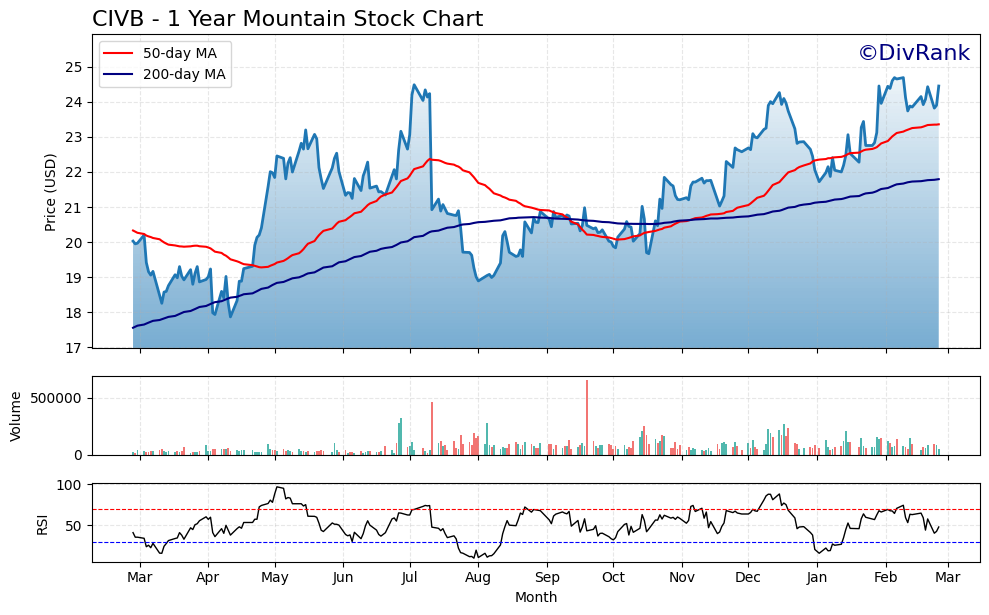
Civista Bancshares has staged an impressive recovery over the past twelve months, climbing from a 52-week low of $17.87 to its current price of $24.45, a gain of roughly 37% from trough to present. That kind of price appreciation in a community bank is meaningful, and it reflects a sustained shift in investor sentiment rather than a brief speculative spike. The stock is now trading just 0.97% below its 52-week high of $24.69, which places it at the upper boundary of its recent range and signals that buyers have been consistently in control through much of the trailing year.
The moving average picture reinforces that constructive trend. CIVB is trading above both its 50-day moving average of $23.36 and its 200-day moving average of $21.79, and critically, the 50-day has crossed above the 200-day to form a golden cross, a technical configuration that typically signals the transition from a recovery phase into a more durable uptrend. The spread between the two averages continues to widen, which suggests the momentum behind this move has not yet exhausted itself. For dividend investors, a stock trading in proper sequence above rising moving averages provides a more stable foundation for holding a position through normal market fluctuations.
The RSI currently sits at 47.89, placing CIVB squarely in neutral territory. This is actually an encouraging reading for long-term income investors, because it means the stock has not been chased into overbought conditions despite its proximity to a 52-week high. A neutral RSI near price highs often indicates that the advance has been orderly and measured rather than driven by short-term momentum traders, which reduces the risk of a sharp mean-reversion pullback that would disrupt a dividend-focused holding period.
Taken together, the technical setup for CIVB is constructive without being stretched. The golden cross, the position above both key moving averages, and the neutral RSI combine to paint a picture of a stock that has rebuilt its technical structure methodically over the past year. For dividend investors evaluating an entry point, the current price sitting just under the 52-week high with balanced momentum suggests the market is not yet pricing in significant exuberance, leaving room for continued appreciation while the dividend does its work.
Cash Flow Statement
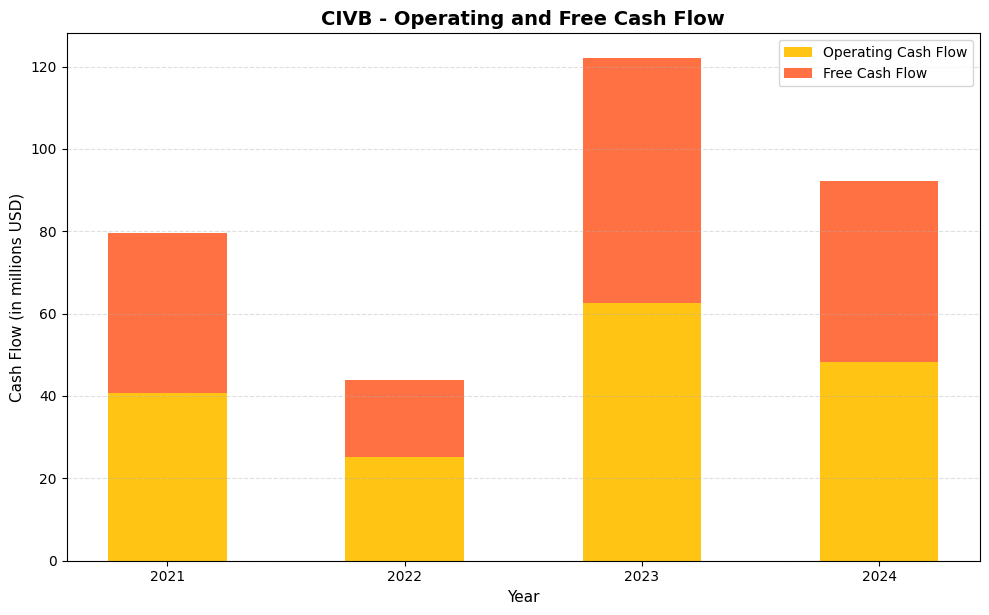
Civista Bancshares has generated consistently positive free cash flow across every year in the dataset, which is the foundational requirement for any dividend we take seriously at DivRank. Operating cash flow peaked at $62.7 million in 2023 before moderating to $48.2 million in 2024, while free cash flow followed a nearly identical path, coming in at $59.3 million in 2023 and $44.1 million in 2024. Even in the weakest year of the period, 2022, when operating cash flow contracted sharply to $25.2 million and free cash flow fell to $18.7 million, the bank still covered its dividend obligations without stress. That 2022 dip is worth understanding in context: rising deposit costs and margin compression weighed on cash generation across the regional banking sector that year, and CIVB was not immune. The recovery to record levels in 2023 demonstrated that the dip was cyclical rather than structural.
One of the more encouraging signals in this dataset is the consistently tight spread between operating cash flow and free cash flow, which tells us that CIVB runs a capital-light model relative to its cash generation. In 2023, capital expenditures consumed only $3.4 million of the $62.7 million in operating cash flow, and the 2024 gap of roughly $4.1 million shows that discipline has been maintained. For dividend investors, this matters because it means management is not sacrificing reinvestment quality to protect the payout, nor is it burning cash on infrastructure at the expense of shareholder returns. The four-year average free cash flow of approximately $40.2 million represents a comfortable cushion above the bank’s annual dividend obligation, giving income investors a reasonable degree of confidence that the current payout is well-supported by the cash the business actually produces.
Analyst Ratings
The analyst community covering Civista Bancshares has a constructive outlook on the stock as of early 2026. With six analysts covering the name and a consensus rating of Buy, the general view is that the current price represents an attractive entry point relative to where the bank’s fundamentals suggest it should trade. The mean price target of $27.17 implies upside of approximately 11% from the current price of $24.45, while the high target of $28.00 points to potential upside closer to 14.5%. Even the low end of the range at $26.00 sits above where the stock is trading today, which means no analyst in coverage currently sees the stock as fully valued.
That kind of target distribution, where every estimate in the range is above the market price, reflects a broadly shared view that Civista is trading at a discount to intrinsic value. At 9.26 times earnings and 0.93 times book, that argument is easy to make on the numbers alone. Analysts have pointed to the bank’s consistent earnings delivery, growing dividend, and conservative capital management as the primary reasons for their positive stances. The absence of any recent analyst downgrades or negative target revisions adds to the picture of a stock that is quietly building credibility with the professional research community. For investors who track analyst sentiment as one input among many, the signal here is clearly constructive.
Earning Report Summary
Civista Bancshares has continued to build on the operational momentum established in prior years, with full-year EPS reaching $2.64 on net income of approximately $46 million. That represents a meaningful step up from the $2.01 per share reported for full-year 2024, reflecting both improved net interest income and continued efficiency in managing the bank’s expense base. Revenue of $169 million for the trailing twelve months confirms that the bank’s core lending and deposit franchise continues to generate steady top-line production.
Net Interest Income and Margin Discipline
The improvement in EPS from $2.01 to $2.64 year-over-year is a substantial jump, and much of it reflects the bank’s ability to benefit from rate positioning while keeping funding costs in check. The rate environment has remained a key variable for regional banks through this period, and Civista appears to have navigated it more effectively than its 2024 results might have suggested. Management’s emphasis on reducing reliance on higher-cost wholesale borrowings and growing core deposits has been a consistent theme, and the earnings improvement suggests that strategy is paying off.
Profitability and Capital Returns
Return on equity of 9.92% and return on assets of 1.10% both represent improvements over prior periods, with ROA in particular crossing above the 1% threshold that is often used as a benchmark for healthy bank profitability. A profit margin of 27.32% indicates that the bank is converting a meaningful share of its revenue into net income, which supports both the dividend and the ongoing buildup of book value. Book value per share of $26.20 continues to grow, providing an expanding floor of intrinsic value beneath the stock price.
Asset Quality and Loan Portfolio
Loan growth has remained a focus for Civista, with residential real estate and construction lending continuing to lead the expansion. The bank operates in Ohio markets where housing demand has remained relatively stable, providing a steady pipeline of lending opportunities without requiring the bank to stretch into riskier asset classes. Credit quality indicators have remained manageable, and the bank’s conservative underwriting culture has helped keep charge-offs and provisions at levels that do not threaten the dividend or capital ratios.
What Leadership Had to Say
CEO Dennis Shaffer has maintained a tone of measured confidence, pointing to the bank’s deposit stability initiatives and earnings growth as evidence that the strategic priorities set out over the past two years are translating into results. The decision to raise the quarterly dividend to $0.18 per share in February 2026 was framed as a direct reflection of the bank’s financial strength and its commitment to returning capital to shareholders in a sustainable way. Leadership has also indicated continued focus on controlled growth within core markets, with no signs of a shift toward aggressive expansion that might introduce new risks.
Management Team
Dennis Shaffer has served as President and Chief Executive Officer of Civista Bancshares for a number of years and remains the defining voice of the company’s strategic direction. His approach is characterized by patience, discipline, and a preference for organic growth and selective acquisitions over headline-grabbing deals. Under his leadership, the bank has consistently prioritized capital preservation, community relationships, and steady earnings delivery over short-term performance metrics.
The broader management team reflects the bank’s regional identity. Civista operates with a relatively lean executive structure appropriate for a bank of its size, with experienced leaders overseeing lending, finance, and operations. The continuity of leadership across key roles has been a stabilizing factor, particularly during periods of interest rate volatility and competitive pressure in the deposit market. Investors looking for a management team that communicates transparently and executes without drama will find Civista’s leadership consistent with that expectation.
Valuation and Stock Performance
At $24.45, Civista Bancshares is trading near the top of its 52-week range of $17.47 to $25.59, which reflects the substantial appreciation the stock has delivered over the past year. Despite that move, the valuation remains compelling on several measures. A P/E ratio of 9.26 is well below the average for U.S. regional banks, and a price-to-book of 0.93 means investors are still buying the bank’s net assets at a slight discount. Book value per share of $26.20 provides a concrete anchor for intrinsic value, and with the stock sitting below that figure, the downside case is cushioned by the balance sheet itself.
The market cap has grown to approximately $507 million, moving Civista solidly into the small-cap tier and increasing its visibility among income-focused funds that screen for yield, coverage, and balance sheet quality. Beta of 0.67 continues to reflect the stock’s low-volatility character, making it a useful anchor for portfolios that need steady income without amplified drawdown risk. With analysts targeting a mean price of $27.17 and every analyst in coverage carrying a target above the current price, the fundamental case for further appreciation from current levels remains intact. The stock is not as cheaply priced as it was a year ago, but at under 10 times earnings and below book value, it is far from fully valued.
Risks and Considerations
Regional banks like Civista are inherently sensitive to changes in the interest rate environment. While the bank has benefited from the recent rate cycle, any significant decline in rates could compress net interest margins and pressure earnings growth, which in turn could slow the pace of dividend increases. The bank’s ability to reprice deposits and loans in a shifting rate environment will remain a key variable for investors to monitor through 2026 and beyond.
Credit quality is always a consideration for a bank with meaningful exposure to residential real estate and construction lending. While Civista’s portfolio has held up well, a deterioration in housing markets or a broader economic slowdown in its Ohio-based footprint could lead to higher provisions for credit losses and a reduction in net income. The bank’s allowance levels and loan-to-value practices offer some buffer, but the risk is not zero and warrants ongoing attention.
Civista’s small-cap status, while not a fundamental flaw, does introduce some practical limitations. Liquidity in the stock is lower than in larger peers, institutional coverage is limited to six analysts, and the bank has fewer levers to pull if it needs to raise capital quickly or pursue a transformative acquisition. Investors in smaller regional banks accept these trade-offs in exchange for the valuation discount, but they should be aware that the discount can persist for extended periods even when fundamentals are improving.
Finally, the competitive deposit environment in regional banking has not disappeared. Larger banks, credit unions, and online deposit platforms continue to compete aggressively for the kind of stable, low-cost deposits that underpin Civista’s net interest income. Management has made deposit retention a strategic priority, and results so far have been encouraging, but maintaining that edge over the medium term requires continued execution and investment in customer relationships and digital capabilities.
Final Thoughts
Civista Bancshares enters 2026 in the best financial shape it has been in for some time. EPS of $2.64, a dividend raised to $0.72 annually, return on assets above 1%, and a book value of $26.20 per share paint a picture of a bank that is quietly compounding value for its shareholders. The payout ratio of 25.76% is among the most conservative in the regional banking space, giving the dividend a safety cushion that few income-oriented stocks at this yield level can match.
The stock is not a screaming bargain the way it was when it traded near the low end of its 52-week range, but at 9.26 times earnings and 0.93 times book, it still offers genuine value relative to the quality of the underlying business. Six analysts with a consensus Buy rating and a mean price target of $27.17 suggest the professional community sees further upside from here. For dividend growth investors seeking a low-volatility, well-covered income stream from a conservatively managed regional bank, Civista Bancshares continues to make a strong case for a place in a long-term portfolio.