

Updated 2/23/26
Wintrust Financial is a regional bank based just outside Chicago that isn’t flashy, but it’s dependable—exactly what long-term dividend investors like to see in their portfolios. Wintrust serves both individuals and businesses through traditional banking, mortgage services, and wealth management. It’s built a loyal customer base across the Midwest by doing the basics well and staying financially grounded. For those who prize stable dividends over rollercoaster returns, WTFC offers a lot to like.
Recent Events
WTFC shares have staged a meaningful recovery from their early-2025 lows near $89, now trading around $149.50 and sitting closer to their 52-week high of $162.96 than their trough. That kind of comeback reflects growing investor confidence in the bank’s fundamentals rather than any speculative enthusiasm. Regional banks broadly have benefited from a more stable rate environment, and Wintrust has been a clear beneficiary.
The trailing twelve months tell an encouraging story. Net income reached $774 million, and earnings per share came in at $11.39—solid growth from the $10.31 posted at the end of 2024. Return on equity has climbed to 12.11%, and return on assets sits at 1.21%, both respectable figures for a bank of this size and business mix. The profit margin of 31.35% reflects disciplined cost management alongside continued revenue expansion.
With a market cap now north of $10 billion and a beta of 0.85, Wintrust has crossed into mid-cap territory while maintaining the lower volatility profile that income investors find appealing. The balance sheet remains conservatively managed, reinforcing the case that this bank is built for the long run rather than short-term performance chasing.
Key Dividend Metrics 🧮
📈 Forward Yield: 1.28%
💰 Annual Dividend: $2.05 per share
🧷 Payout Ratio: 17.54%
📅 Most Recent Dividend Payment: $0.55 per share (February 5, 2026)
⛳ Ex-Dividend Date: February 5, 2026
🪙 5-Year Average Yield: ~1.73%
📉 Beta (5Y): 0.85
🔁 Last Stock Split: 3-for-2 (March 2002)
These figures show a picture of consistency paired with measured growth. Wintrust isn’t chasing high yields to attract income hunters. Instead, it delivers sustainable, well-covered returns that don’t put pressure on the business during tougher times—and it has quietly been raising that payout at a steady clip.
Dividend Overview
A 1.28% yield might not sound exciting at first glance, especially when compared to high-yield sectors like energy or real estate. But sometimes boring is beautiful—particularly when the dividend is this well-covered and actively growing. Wintrust’s payout ratio remains under 18%, which leaves the company plenty of flexibility to maintain or increase its dividend regardless of short-term swings in earnings.
That low payout ratio tells you management isn’t trying to impress by over-distributing. They’re building a cushion—ensuring the dividend isn’t just for now, but for years ahead. For long-term investors, this kind of discipline matters more than a few extra basis points of current yield, especially when that yield is backed by $11.39 in earnings per share against just $2.05 in annual dividends.
Wintrust also doesn’t have a history of cutting its dividend when things get tough. It has shown a steady hand through market cycles, which is exactly the kind of consistency you want if your goal is to rely on dividend income over the long haul. The most recent $0.55 quarterly payment, declared in early February 2026, marks the latest step in an ongoing upward trajectory.
Dividend Growth and Safety
The dividend history here tells a compelling growth story. Wintrust held its quarterly payment at $0.40 through most of 2023, then raised it to $0.45 in early 2024—a 12.5% increase. In early 2025, it stepped up again to $0.50, and then most recently bumped to $0.55 per quarter in February 2026, good for another 10% increase. That brings the annualized dividend to $2.05, up from $1.60 just two years ago—a 28% increase over that span. For a bank with a conservative payout ratio, that pace of growth is genuinely impressive.
Book value per share now stands at $102.03, and with the stock trading at $149.50, the price-to-book ratio is 1.47. That’s a modest step up from where valuations stood a year ago, and it reflects the market’s growing appreciation for Wintrust’s earnings power. It’s a vote of confidence grounded in fundamentals rather than momentum.
The balance sheet continues to support a safety argument for the dividend. With earnings per share at $11.39 and dividends consuming only $2.05 of that, the coverage ratio sits near 5.5x—one of the more comfortable margins you’ll find among dividend-paying regional banks. There’s no leverage-driven pressure on the payout, and the bank’s return on equity north of 12% shows management is deploying retained capital productively. Shareholders are being rewarded without the business being stretched to do it.
Cash Flow Statement
Wintrust Financial’s cash flow profile over the trailing twelve months reflects a well-capitalized institution continuing to invest aggressively in its growth strategy. While specific operating and free cash flow figures aren’t broken out in the most recent data, the income statement and balance sheet dynamics paint a clear picture of a bank generating strong internal cash generation—net income of $774 million on revenues of $2.63 billion speaks to that directly.
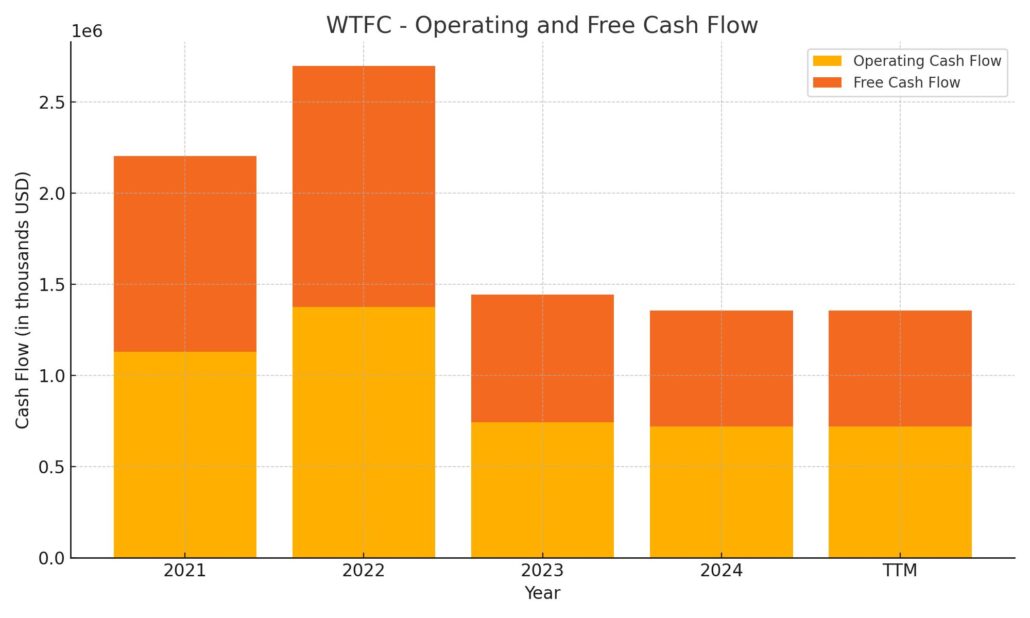
The profit margin of 31.35% is a meaningful improvement from prior periods and indicates that revenue growth is being captured efficiently at the bottom line. For a regional bank of Wintrust’s size, that level of profitability per dollar of revenue reflects disciplined expense management and a favorable mix of higher-margin lending and fee businesses. The return on assets of 1.21% is another benchmark worth highlighting—it sits comfortably above the 1% threshold that analysts often use as a dividing line between average and well-run banks. With capital expenditures remaining modest relative to earnings, the bank’s capacity to fund dividend growth, balance sheet expansion, and potential acquisitions simultaneously remains intact.
Analyst Ratings
Analyst sentiment on Wintrust Financial remains broadly constructive heading into early 2026. The stock’s move from the low $100s to the current $149.50 level has compressed some of the upside implied by earlier price targets, but the fundamental thesis—steady earnings growth, disciplined capital allocation, and a conservative credit culture—hasn’t changed, which is why coverage remains positive rather than fading.
Firms that had price targets in the $150–$157 range as of mid-2025 are likely revisiting those figures upward given the improvement in EPS from $10.31 to $11.39 over the past year. A bank earning nearly $11.40 per share with a payout ratio below 18% and return on equity above 12% warrants a P/E in the low-to-mid teens, which is precisely where the market has the stock priced today at 13.13x earnings. That’s not stretched by historical standards for a well-run regional bank.
The consensus view among analysts who cover WTFC is that the bank continues to execute well above peer averages on credit quality and balance sheet efficiency. The stock’s beta of 0.85 makes it a lower-volatility option within the regional banking space, which has historically commanded a premium valuation relative to more cyclically exposed peers. With book value per share at $102.03 and the stock at a 1.47x price-to-book multiple, there’s still a reasonable valuation argument even after the strong run higher. Analysts watching the specialty finance segments—particularly equipment finance and insurance premium finance—are likely to remain positive as those businesses continue scaling.
Earning Report Summary
Wintrust Financial’s most recent trailing twelve-month results confirm that the bank has continued building on the momentum it established heading into 2025. Net income reached $774 million, translating to $11.39 per share—a meaningful step up from the $10.31 reported at the close of 2024. Revenue came in at $2.63 billion, and the profit margin expanded to 31.35%, reflecting both top-line growth and continued cost discipline.
Earnings Per Share Acceleration
The jump from $10.31 to $11.39 in EPS over the past year represents roughly 10% growth, consistent with Wintrust’s historical pattern of steady rather than explosive earnings expansion. What makes this more impressive is that it’s occurring as the bank continues to grow its balance sheet and fund investments in specialty lending. Return on equity at 12.11% and return on assets at 1.21% both represent improvements from the prior period and demonstrate that growth isn’t coming at the expense of quality.
Specialty Lending Pulling Its Weight
The specialty finance businesses—equipment finance and insurance premium finance in particular—continue to be core contributors to earnings growth. These segments generate higher margins than traditional commercial banking and provide diversification against rate-driven compression in the net interest margin. Management has consistently highlighted these areas as strategic priorities, and the financial results are validating that focus.
Solid Credit Performance
Credit quality metrics remain a standout for Wintrust relative to the broader regional banking peer group. Non-performing loan ratios have stayed low, and reserve levels remain adequate to absorb potential stress without disrupting capital return plans. This conservative credit culture is one reason the dividend feels as safe as it does—the bank isn’t generating earnings through aggressive risk-taking that could unwind quickly in a downturn.
Balance Sheet and Capital Position
Book value per share grew to $102.03, and the market is now assigning a 1.47x price-to-book multiple—evidence that investors are increasingly pricing in the quality of earnings rather than treating the bank as a purely asset-value story. With a market cap that has crossed $10 billion, Wintrust is firmly in mid-cap territory, which may attract a broader base of institutional buyers over time. Overall, the bank enters the back half of fiscal 2026 with momentum on earnings, credit quality, and capital strength all moving in the right direction.
Management Team
Wintrust Financial Corporation is led by a team with deep experience in banking and financial services. At the top is Timothy S. Crane, who serves as President and CEO. With a four-decade career spanning retail, commercial, and wealth banking, Crane brings a practical, well-rounded approach to leadership. Since joining the company in 2008, he’s played a major role in overseeing its network of more than 180 locations through 15 community banks, and the bank’s consistent earnings performance under his tenure reflects that steady hand.
Edward J. Wehmer, the founder of Wintrust, now serves as Founder and Senior Advisor. His long-term leadership helped shape the company’s culture and strategic direction from the ground up. Under his guidance, Wintrust built a reputation as a community-focused and customer-centric institution that prioritizes sustainable growth over short-term gains—a philosophy that remains evident in today’s payout ratio and capital allocation decisions.
Also key to the leadership team is David A. Dykstra, Vice Chairman and COO. His focus has long been on operations and risk management, ensuring the company runs efficiently and stays on solid footing through various credit and rate cycles. Together, this leadership group has guided Wintrust through multiple market environments while maintaining an emphasis on stable growth and responsible risk-taking—qualities that dividend investors should find reassuring.
Valuation and Stock Performance
As of February 23, 2026, Wintrust stock is trading at $149.50, well above the $89.10 low set over the past 52 weeks and approaching the high end of the $89.10–$162.96 range. The stock’s recovery from those lows has been substantial, and it reflects a re-rating driven by improving earnings rather than multiple expansion alone. A P/E of 13.13x on $11.39 in earnings is a reasonable price to pay for a bank generating 12% returns on equity with a conservative credit profile.
The price-to-book ratio of 1.47x—against a book value of $102.03 per share—sits in comfortable territory for a bank of this quality. It’s not demanding, but it’s no longer the deep discount that existed when the stock was trading in the low $100s. Investors buying at current levels are paying for a business that has earned its premium through consistent execution. The market cap crossing $10 billion is a milestone that could attract incremental institutional interest, which may support the stock’s ability to sustain current valuation levels.
Short interest of approximately 1.92 million shares is modest relative to the float, suggesting limited bearish conviction among active traders. With beta at 0.85, WTFC continues to offer a smoother ride than the broader regional banking sector, and that characteristic tends to be particularly valuable during periods of macro uncertainty. For dividend growth investors, the combination of a reasonable valuation, rising earnings, and a growing dividend makes the current setup worth serious consideration.
Risks and Considerations
Like any financial institution, Wintrust faces a number of risks that investors should keep in mind. One of the larger ongoing challenges is regulatory compliance. Whether it’s fair lending rules, privacy standards, or cybersecurity requirements, the bank operates in a tightly controlled environment that demands constant attention and investment. As the bank crosses $10 billion in market cap and continues growing total assets, regulatory scrutiny may increase alongside its balance sheet footprint.
Interest rate sensitivity remains a factor to monitor. Wintrust has benefited from a relatively stable rate environment over the past year, with net interest margins holding up well. Any meaningful shift—whether rates move sharply higher or begin declining—could affect the net interest income that drives the bulk of the bank’s earnings. Management has historically navigated rate cycles competently, but the risk remains real and worth tracking on a quarterly basis.
Credit quality, while strong today, is always susceptible to macroeconomic deterioration. Non-performing loan ratios are low, and reserves are adequate, but a recession or significant softening in the Midwest commercial real estate or small business environment could pressure charge-offs higher. The bank’s conservative underwriting standards provide a buffer, but no institution is fully insulated from a broad economic downturn. ESG and climate-related risk frameworks are also becoming more prominent in regulatory expectations, and Wintrust, like its peers, will need to continue developing those capabilities over time.
Final Thoughts
Wintrust Financial continues to present a compelling case for dividend growth investors who prioritize safety, consistency, and measured capital return over headline yield. The dividend has grown from $0.40 per quarter in 2023 to $0.55 today—a 37.5% increase in the quarterly payment over roughly two and a half years—while the payout ratio has barely moved, staying under 18%. That’s what a healthy dividend growth story looks like in practice.
The current valuation at 13.13x earnings and 1.47x book is fair rather than cheap, but it’s supported by a business that is genuinely improving. EPS of $11.39, return on equity above 12%, and a profit margin expanding toward 32% are not the metrics of a bank coasting on favorable conditions—they reflect real operational improvement. The stock’s beta of 0.85 and market cap now above $10 billion add stability characteristics that suit income-oriented portfolios.
There are real risks here—rate sensitivity, credit cycle exposure, and a regulatory environment that only grows more complex as the bank scales. But Wintrust’s track record of managing those challenges conservatively gives investors a reasonable basis for confidence. For those building a dividend growth portfolio anchored in quality regional banking, WTFC remains a name worth owning.